Rapid eye movement (REM) sleep behavior disorder is a sleep disorder in which you physically act out vivid, often unpleasant dreams with vocal sounds and sudden, often violent arm and leg movements during REM sleep — sometimes called dream-enacting behavior.
This sleep condition is a lesser-known symptom of Parkinson’s that, in some people, can precede movement symptoms (tremor, stiffness, slowness) and diagnosis by years or even decades.
What do the 1974 song “Dreamer” by Supertramp, and 1977 song “That Smell” by Lynyrd Skynyrd have in common? I have no idea… but they do remind me of a couple of Parkinson’s symptoms! Vivid dreams and loss of smell.
They both can be early symptoms of Parkinson’s! Acting out dreams during sleep is also known as REM sleep behavior disorder (RBD), and is a common sleep problem for people with Parkinson’s disease. RBD can occur yearsbefore a Parkinson’s diagnosis and can be one of the first symptoms.
RBD can be dangerous and can put the person experiencing it, and their sleeping partner at risk. People with RBD may kick, punch, or yell while they sleep. Many of my fellow boxers have moved to separate beds for sleeping out of fear of harming their partner!
Normally when we dream, our brain prevents our muscles from moving. In some, these brain signals don’t work properly, and a person moves while dreaming. This is REM sleep behavior disorder (RBD). People with RBD often have very active dreams in which they’re playing sports, running, or even being chased or attacked.
RBD is a risk factor for Parkinson’s and other brain diseases. Not everyone with RBD gets Parkinson’s disease. But in some people, RBD is one of the earliest symptoms of Parkinson’s.
Similar to RBD, ongoing smell loss can also indicate risk for Parkinson’s disease. After a diagnosis, some people with Parkinson’s report losing their sense of smell years or even decades earlier. This condition is called hyposmia.
Not everyone with smell loss will develop a brain disease. Researchers are studying the link between smell loss and brain health to learn more about Parkinson’s risk.
My wife and I thought I suffered from Post-Traumatic Stress Disorder (PTSD) due to having been a cop for over 35 years…. There are a lot of things I cannot unsee that I wish I could. My RBDs have been going on for years. My adult kids remember them when they were growing up!
Some of the worse RBDs I can remember are pinning my son to the floor while clinching a fist over him. He was just trying to wake me up to let me know he had made it home safe from work. Others include waking up to hitting myself in the face! I had thought my older brother had me in a head lock… I was trying to punch him, but was only hitting myself. Or the times I was hitting the nightstand next to my bed. The nightstand won! Other times waking up to punching the dresser. There were times I hit my wife while she was sleeping. Luckily, in all my incidents the only one having been hurt, was me … thank God, I never hurt her.
My wife’s solution, other than sleeping in separate rooms was to add a bedrail, to keep me from falling out bed, removing sharp objects from the room, and adding large cushions to keep us separated!
I still suffer from RBDs, but a prescription for clonazepam has helped reduce the frequency. I still don’t smell really well, but that is probably a good thing?
See https://www.michaeljfox.org/ for additional information about dreams, smells and other things as they relate to Parkinson’s.
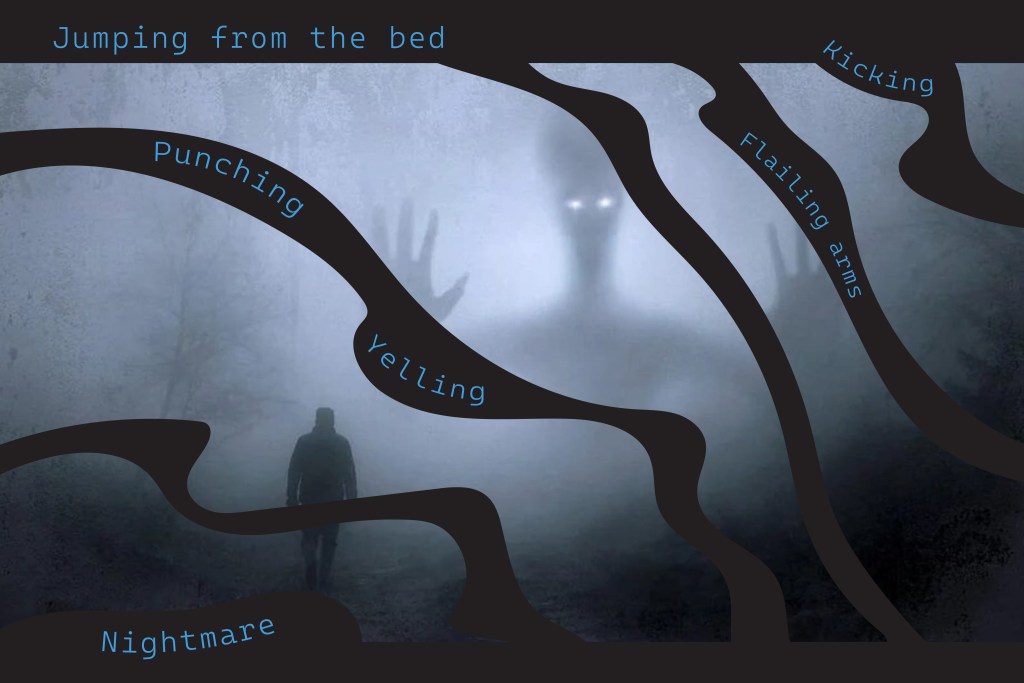
What Is REM Sleep Behavior Disorder? In REM sleep behavior disorder, a person acts out their dreams. Because these dreams often involve being chased or attacked, people will yell, punch, kick or even leap out of bed.
REM is the period of sleep during which we dream. Normally, the brain inhibits muscle movement during this time. In RBD, the brain pathways that suppress muscle activity are disrupted, and people are able to move to act out their dreams.
David: No way I didnt!?
Pam: Uh yeah you did!! Want me to put a camera up so you can see yourself?
His dreams are pretty intense and sometimes its hard to get him to snap out of it. Waking him up is not enough. I have to get him up and walking or he will go right back into the dream.
How Is RBD Diagnosed? The diagnosis of RBD rests on your story and a sleep test. A sleep doctor will ask you and your bedpartner about behaviors during sleep. An overnight sleep study records brain waves and muscle activity while you sleep and may also include taking a video to show you acting out your dreams.
David:
Pam: With all the dream shenanigans going on at night there is little sleep for us. Sometimes we both feel like Zombies during the day.
What Is the Treatment for RBD? If RBD causes injury or poses risks of harm to you or your bedpartner, your doctor may suggest medication and safety measures. Some medications (such as certain antidepressants or pain drugs) can cause RBD, so your doctor may change those medicines before adding another.
Commonly prescribed medications for RBD are clonazepam and melatonin. Clonazepam can cause confusion and falls, so doctors prescribe it cautiously in people with memory and thinking changes or walking and balance problems.
Safety measures may include adding a bed rail, padding corners of furniture, and removing potentially dangerous objects (such as guns or sharp objects) from the bedroom. Sometimes the bedpartner may need to sleep in a separate room until RBD is controlled.
FIX HIM!!!
Pam: I go into full “fix it” mode! I read every book and search all the sites. There has to be a way to make this right!!???
How Is RBD Connected to Parkinson’s Disease? Sleep problems, including RBD, are common in people who’ve been diagnosed with Parkinson’s. But studies suggest that REM sleep behavior disorder also can be one of the first symptoms of PD, occurring years before motor symptoms. (Other possible early signs include constipation, depression and smell loss.) These studies demonstrate a strong link between having RBD and later being diagnosed with Parkinson’s or related conditions such as dementia with Lewy bodies or multiple system atrophy, which have PD symptoms. Not everyone with RBD goes on to develop PD, though.
Pam: The one thing I love the most, is the big hugs I get for standing by him, loving him through it all and for helping him!! He is still my rock!!
What if I Have RBD? If you act out your dreams, talk to your doctor. Other sleep problems may mimic RBD, so it’s important for a sleep specialist to confirm the diagnosis. If you do have RBD, you may want to see a movement disorder specialist (a neurologist with expertise in Parkinson’s and other movement disorders) who can check for Parkinson’s motor symptoms and talk through your risk of developing PD or related conditions. Your movement disorder specialist may recommend regular visits to repeat the examination and monitor for changes.
You also may want to consider joining a research study. Studies such as MJFF’s Parkinson’s Progression Markers Initiative (PPMI) follow people with RBD over time to determine factors that predict, prevent or push to Parkinson’s. Register with our Fox Trial Finder site to be matched with Parkinson’s studies that need volunteers.
Read about one person’s challenges with sleep due to PD.John Cobb: My Challenges with REM Sleep and Parkinson’s Disease read here
Watch the video to learn more and to hear one couple’s experience living with RBD.



 My Journey With Parkinson's - David Zanghi
Leave a comment